

Most office chairs sport fixed arms because they’re simpler to make, cheaper to buy, and they last longer. Manufacturers skip the moving parts—those sliders and pivots that wear out—cutting costs and assembly steps considerably. Standard 7-9 inch heights fit most typing tasks just fine. Plus, fixed designs mean fewer repairs, predictable pricing, and easier bulk purchasing for companies outfitting entire offices. You’re trading some personalization for rock-solid reliability and affordability. But there’s more nuance here about what you might be giving up.
The Economics of Fixed Armrests: Why Simplicity Wins

Why do manufacturers love fixed-armrests so much? They’re simpler to build, which means lower costs and fewer things that break. When you eliminate adjustable mechanisms, you’re cutting out dozens of moving parts and assembly steps. That’s huge for production efficiency.
I’ve noticed that fixed-armrests require significantly less inventory variety, reducing procurement headaches for companies buying office furniture in bulk. Fewer parts mean faster assembly lines and straightforward quality control. There’s genuine pride in that streamlined approach—it’s elegant problem-solving.
Plus, simpler designs speed up regulatory testing and compliance, getting chairs to market quicker. With minimal moving components, repair rates plummet, delivering real savings over time. Organizations benefit from predictable performance across their entire workspace. It’s not flashy, but it’s brilliantly practical economics.
How Fixed Arm Design Outlasts Adjustable Mechanisms

How much longer do you think a chair’s arms last when they’ve got zero moving parts?
I’m telling you, fixed armrests are durability champions. Here’s why they win:
- No wear zones: Sliders and pivots degrade quickly, but stationary armrests skip that problem entirely
- Consistent support: Without joints shifting over time, your arms stay aligned exactly where they should be
- Zero maintenance: You’re not replacing worn parts or resetting loose mechanisms every few months
When I compare fixed designs to adjustable ones, the difference is striking. Adjustable armrests rely on multiple locking mechanisms and moving joints that eventually fail. Fixed arms? They endure because simplicity means strength. That mechanical drift adjustable chairs suffer from never happens here. You get years of reliable support without the frustration of degradation creeping in.
One Size Fits Most: Why Fixed Arms Support Diverse Workforces

I’ve found that manufacturers stick with fixed arms because they’ve nailed a sweet spot: standard heights around 7-9 inches work for most people doing typical desk work like typing and emailing, keeping production costs way down. When you’re building chairs by the thousands, that consistency in dimensions means fewer customization headaches and a price tag that won’t make your budget wince. Sure, it won’t be perfect for everyone—someone really tall or short might feel the squeeze—but that one-size-fits-most approach is why quality office chairs remain affordable for everyday workplaces instead of luxury items.
Cost-Effective Manufacturing Standards
When you’re buying office chairs in bulk for your company, here’s the thing: fixed armrests hit the sweet spot between keeping workers comfortable and keeping budgets from exploding.
Manufacturers simplify production by standardizing designs with fixed arms. You’ll notice this reduces tooling complexity—basically, the expensive equipment needed to shape parts. Fewer moving components mean lower costs across the board.
Here’s what makes fixed arms so practical:
- Fewer failure points mean less maintenance headaches down the road
- Faster assembly speeds up delivery when you need chairs yesterday
- Standardized configurations align perfectly with typical workstations
Fixed arms represent smart manufacturing thinking. They’re not cutting corners—they’re being strategic. By embracing this straightforward approach, companies like yours get reliable seating that works across diverse teams without draining resources. That’s genuine value.
Standardized Dimensions For Accessibility
Why’d manufacturers settle on fixed arms as the universal solution for office seating? They’re designing for you—and everyone else. Standardized armrests hit that sweet spot where one height works for most people’s elbows and forearms, creating what designers call “one size fits most” accessibility. I love how this approach means your workplace can outfit entire departments with matching chairs that genuinely accommodate different body types. Fixed armrests simplify everything from ordering to maintenance across your office fleet. Sure, someone exceptionally tall or short might feel the squeeze, but the strategy brilliantly serves the broadest range of users without complicated adjustments. It’s inclusive design thinking meeting practical business sense—furniture that welcomes you exactly as you are, no special requests needed.
Desk Compatibility: How Fixed Designs Prevent Workspace Conflicts

How many times have you watched someone squeeze into a cubicle, only to have their chair’s armrests bang against the desk edge?
Fixed arms solve this frustration completely. Here’s why desk compatibility matters:
- Predictable spacing fits standard 48-60 inch desk widths without reshaping
- Zero pivot risk keeps forearms aligned during keyboard work near edges
- Consistent clearance protects mouse areas from accidental armrest contact
I’ve noticed that rigid armrests simplify everything. Manufacturers can test chairs against typical workstations before shipping, ensuring you won’t experience that annoying collision when reaching for documents. These fixed designs eliminate the variability that causes layout conflicts in shared offices.
You’re not constantly adjusting or worried about your setup. That predictability? It’s genuinely worth celebrating. Fixed arms create workspace harmony that moving parts simply can’t match, especially when you’re working alongside colleagues in tight quarters.
The Ergonomic Compromise: What Fixed Arms Can’t Personalize

Despite all that desk harmony I just praised, there’s a real catch hiding underneath those rigid armrests—they’re basically one-size-fits-most solutions that ignore who you actually are. Your armrests can’t adjust their height, width, or depth to match your unique arm length and desk setup. This forces your shoulders and elbows into awkward angles that don’t fit your body, creating strain in your neck, upper back, and wrists over time. While manufacturers save money and complexity by keeping armrests fixed, you’re paying the real price through discomfort and poor posture. Even generously sized fixed armrests fail because everyone’s different—your desk height, arm reach, and how you work demand customization that rigid designs simply can’t provide.
Why Adjustable Mechanisms Fail in Shared Workspaces
When you’ve got multiple people using the same chair throughout the day, that adjustable arm mechanism—whether it’s a knob, lever, or ratchet system—gets cranked up and down constantly, which wears out the internal parts way faster than a chair used by one person. I’ve noticed that shared workspaces create this frustrating cycle where users either neglect to reset the arms to a neutral position between shifts, causing gradual drift and looseness that makes positioning unreliable, or they adjust so frequently that the mechanism simply gives out under the constant stress. The real kicker is that fixing these mechanisms costs facilities money and service calls, so they’d rather skip adjustability altogether and stick with sturdy fixed arms that’ll survive high-traffic environments without constant maintenance headaches.
Daily Reset Requirements Drain Time
Why’s it that the moment a coworker leaves their desk, that fancy adjustable armrest—the one that promised personalized comfort—has drifted completely out of whack? In shared workspaces, resetting armrests to their neutral starting point becomes a daily chore that eats into productivity. Here’s what’s really happening:
- Each shift requires re-adjusting height, width, and depth settings that users forget or inadvertently nudge out of place
- Cleaning routines and frequent occupant turnover constantly knock armrests misaligned
- Without standardized reset protocols, new users waste precious minutes reconfiguring what should’ve stayed put
You’re essentially solving the same problem repeatedly, which drains time and frustration. That’s why many facilities abandon adjustable solutions altogether—fixed armrests eliminate this daily hassle, sacrificing personalization for predictable consistency across multiple users.
Mechanism Wear From Frequent Adjusting
Beyond the frustration of constant resetting lies a harder truth: those adjustable mechanisms themselves are literally breaking down under the strain. Every time someone adjusts your armrests up, down, forward, or back, tiny metal joints experience stress. In shared offices, this happens dozens of times daily across multiple users.
Ratchet mechanisms weaken. Friction joints loosen. The padding compresses where forearms repeatedly contact the surface. I’ve watched chairs decline from smooth adjustments to stubborn, binding resistance within months. Users then compensate with awkward postures, stressing components further.
That’s the cycle: frequent adjustments accelerate mechanical fatigue, reducing durability faster than manufacturers intended. Eventually, nobody wants to touch the controls anymore because they’re broken. Fixed armrests sidestep this entirely.
User Negligence And Drift Issues
How quickly does an adjustable armrest fall apart when five different people use the same chair every single day? You’d be surprised—sometimes within weeks. Here’s what actually happens in shared workspaces like yours and mine:
When nobody owns the chair, nobody maintains it. Each person adjusts the armrests differently, then leaves them misaligned. Over time, this constant tweaking loosens the pivot mechanisms until they won’t stay put anymore.
Consider these realities:
- Different users reset armrests to wildly different heights, creating cumulative strain on adjustment mechanisms
- Nobody documents optimal settings, so ergonomic improvements get lost between shifts
- Pushing chairs under desks applies sideways pressure that gradually misaligns everything
Without formal assessments guiding your team, armrests just drift into uselessness. That’s why fixed arms win—they’re reliable, predictable, and maintenance-free.
Less to Break: Why Simplicity Means Fewer Repairs
When you really think about it, simpler is almost always better—and office chairs prove this beautifully. Fixed armrests eliminate the mechanical complexity that makes adjustable models vulnerable to failure. Without levers, knobs, or pivot joints, there’s simply less that can break, loosen, or drift out of alignment over time. I’ve noticed that chairs with fewer moving parts require dramatically fewer repairs, which means less downtime in busy offices. Simpler designs mean faster manufacturing too, so replacement parts stay readily available and affordable. When you’re managing a shared workspace or high-traffic environment, this reliability matters tremendously. You’re not constantly calling maintenance or replacing broken components. That’s the real beauty of fixed armrests—they deliver dependable comfort without the headaches that adjustable alternatives bring.
Why Companies Choose Fixed Arms: Cost vs. Flexibility
When you’re outfitting an entire office with dozens of chairs, the math becomes pretty simple—fixed arms cost markedly less to manufacture and purchase than fully adjustable models, which means your company’s upfront investment drops noticeably. I’ve noticed that smart workplace budgets factor in not just that initial savings, but also the long-term reality: fewer moving parts mean fewer repairs down the road, so you’re protecting your bottom line year after year. That’s why you’ll see fixed-arm chairs everywhere from call centers to shared hot-desking spaces—they’re the practical choice when flexibility takes a backseat to predictable, manageable costs.
Manufacturing And Production Economics
Why do manufacturers stick with fixed arms when adjustable alternatives exist? The answer lies in cost efficiency and production simplicity. I’ve discovered that eliminating moving parts transforms manufacturing entirely.
Here’s what changes when companies choose fixed arms:
- Faster production lines that reduce labor hours and factory overhead
- Simplified quality control with fewer components to test and monitor
- Lower tooling costs since machines don’t need to produce complex adjustment mechanisms
Standardizing fixed arms across models means companies can buy materials in bulk, streamline inventory management, and maintain consistent industrial design aesthetics. The result? Predictable pricing and shorter lead times that benefit everyone in the supply chain. That’s genuinely thrilling for budget-conscious buyers seeking reliable office seating without lengthy waits.
Long-Term Workplace Budget Planning
How do savvy corporate managers stretch their furniture budgets across hundreds of employees? They’re choosing fixed armrests—and honestly, it’s brilliant planning.
I’ve watched companies standardize on fixed-arm designs because the math works beautifully. You’re looking at predictable costs when ordering 200 chairs with identical armrests versus juggling adjustable variations. No surprise expenses, no complicated warranty claims about broken adjustment mechanisms.
Here’s what gets me excited: these choices aren’t compromises—they’re strategic wins. Fixed armrests lower maintenance headaches. You’re not replacing worn pivot joints or dealing with liability concerns around customization. That’s money staying in your budget for other improvements.
When paired with quality desks and proper seating programs, fixed armrests actually deliver solid ergonomic support. Your team gets comfortable workstations. You get predictable spending. Everyone wins.
How Fixed Armrests Compare to Adjustable Options
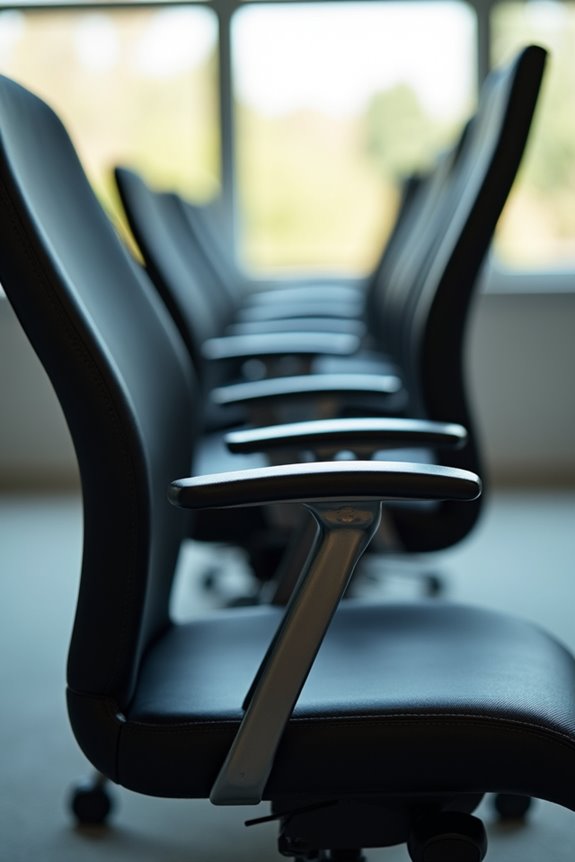
The difference between fixed and adjustable armrests might seem small, but I’ve found it’s actually huge when you’re sitting for eight hours straight. Fixed armrests lock you into one position, forcing your shoulders and wrists into uncomfortable angles that don’t match your body. Adjustable armrests? They’re game-changers.
Fixed armrests lock you into one position. Adjustable armrests? They’re game-changers for eight-hour workdays.
Here’s what I’ve noticed:
- Height adjustments let your forearms rest parallel to your desk, reducing strain
- Width and depth changes prevent desk interference and keep elbows beneath your shoulders
- Customization options adapt as your needs shift throughout the day
With fixed armrests, poor posture sneaks in gradually—slouching, elbow winging, neck tension. Adjustable options eliminate these issues entirely. Over months and years, that flexibility matters tremendously for your spine and overall comfort.
When Fixed Arms Aren’t Enough: Recognizing the Limits

All those benefits I just mentioned? They’ve got real limits. Here’s the thing: fixed arms don’t work for everyone. Your body’s unique—your arm length, shoulder width, and desk height all matter. When fixed armrests don’t match your setup, you’re forced into uncomfortable positions that strain your neck, shoulders, and elbows over time.
That 12% of your body weight your arms carry? It needs proper support. Without adjustable armrests, you can’t fine-tune height or width to find your neutral position. You might slouch forward, reaching past fixed arms, or sit awkwardly angled away from your desk.
Many offices are ditching one-size-fits-all designs because they simply don’t protect diverse workers. If you’re experiencing discomfort, your chair’s probably screaming that it needs adjustability. Listen to it.
Hybrid Armrests: The Evolving Middle Ground

What if you didn’t have to choose between a chair that costs a fortune and one that leaves your arms dangling? That’s where hybrid armrests come in. They’re the smart compromise—offering some height and depth adjustments while keeping lateral width locked. You get meaningful customization without the sticker shock of fully adjustable arms.
Here’s what makes them work:
- Height adjustments let you align armrests with your desk
- Depth changes accommodate different torso lengths
- Fixed width keeps manufacturing costs down
I’ve noticed users genuinely appreciate this balance. These armrests support neutral elbow angles across various desk heights, making shared workstations simpler to set up. Sure, they won’t pamper extreme body dimensions like premium options do, but for everyday tasks? They’re genuinely solid. You’re getting versatility without breaking the bank or your workspace budget.